Crime Scene, Cleveland
Torso Murders (1935-1938)
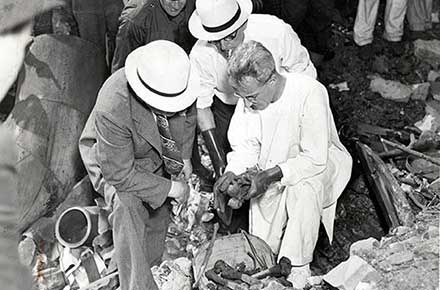
Inspecting remains of torso murderer victim, 1938.
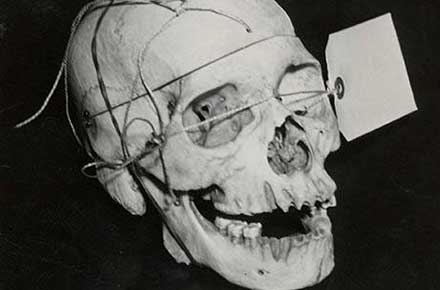
Torso murder evidence, 1939.
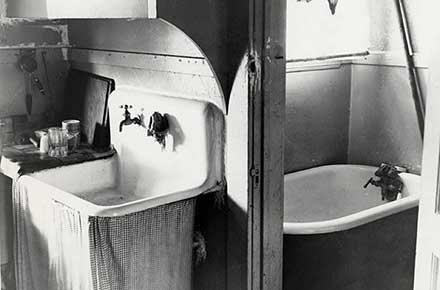
Torso murder tub, 1939.
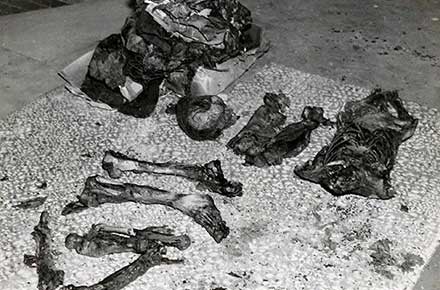
Remains of torso murderer victim, 1938.
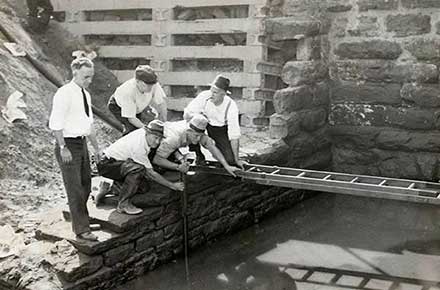
Searching for torso murderer victims, 1936.
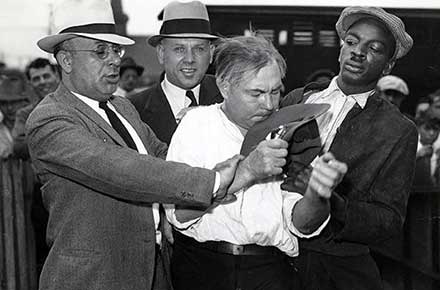
Taking in a torso murder suspect, 1936.
September 23, 1935 — Two dismembered bodies were found together in a creek bed that runs from the flats to about E. 90th Street. These would be the first two of 12 serial killings committed between Sept. 1935 and Aug. 1938 in or near the Kingsbury Run area. The murderer was never found.
Figuring prominently in the investigation was Cleveland Safety Director, Eliot Ness, who ordered the shantytowns of Kingsbury Run burned to the ground. This ended the string of gruesome murders.
For Further Investigation
- The Kingsbury Run Murders - from the Cleveland Police Historical Society
- Torso Murders entry from the Encyclopedia of Cleveland History
Eliot Ness in Cleveland (1935-1942)
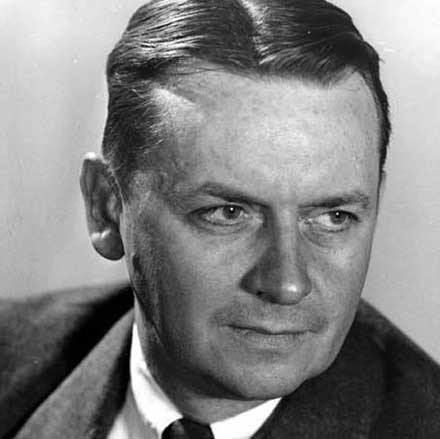
December 1935 — Following his success in bringing down Al Capone in Chicago and his successful turn as the investigator in charge of the Treasury Department's Alcoholic Tax Unit in northern Ohio, Eliot Ness was appointed as Cleveland's Safety Director by Mayor Harold Burton. He was hired to clean up the corruption in the city's scandal-ridden police department and to establish a safe environment in Cleveland. With a contingent of 34 agents under him, much like his “Untouchables” in Chicago, Ness was able to bring 15 officials to trial and garner the resignations of 200 police officers.
As Safety Director, Ness was responsible for burning down the Kingsbury Run shantytowns during the Torso Murders investigation, ending the murderer's crime spree. He also did much to improve traffic control in Cleveland, which, at the time held the record of second-worst American city in traffic-related deaths and injuries. Ness' s contributions to Cleveland's safety were numerous and culminated in his unsuccessful bid to run for Mayor on the Republican ticket in 1947.
For Further Investigation:
- Eliot Ness entry from the Encyclopedia of Cleveland History
- Eliot Ness article from the FBI, Freedom of Information Act
- Eliot Ness Biography
Sheppard Murder Case (1954-1966)
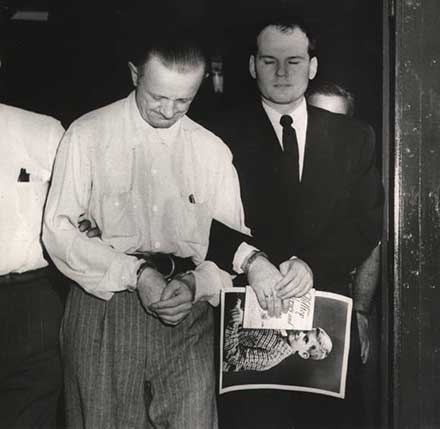
Dr. Samuel Sheppard (right), is led away to a car to begin the trip to the Ohio Penitentiary, 1955.
Browse all Sheppard murder case photos.
July 4, 1954 —The beating death of Marilyn Sheppard in the early morning hours at the Bay Village home she shared with her husband, Samuel Sheppard and their son sparked a controversial murder trial that could be considered the O.J. Simpson case of its day.
Police were suspicious of Sheppard's claims that the murder was perpetrated by a bushy-haired man, and he was arrested on July 30th. As a media circus proliferated throughout the trial, the defense was ultimately unable to convince the jury of Sheppard's innocence. On December 21, 1954 Dr. Sheppard was convicted of 2nd degree murder and was sentenced to life in prison.
After appeals, a Supreme Court ruling and a subsequent retrial in 1966, Sam Sheppard was found not guilty.
The Sheppard case has had an influence on our popular culture providing the premise for a television series (The Fugitive, 1963; remade in 2000) and a motion picture (The Fugitive, 1993).
For Further Investigation:
- The Sam Sheppard Case 1954-2000 - digitized case materials from the Cuyahoga County Prosecutor's Office, now on repository in the Cleveland-Marshall College of Law Library.
- Sheppard Murder Case - from the Encyclopedia of Cleveland History
Car Bomb Kills Cleveland Racketeer, Danny Greene (October 6, 1977)
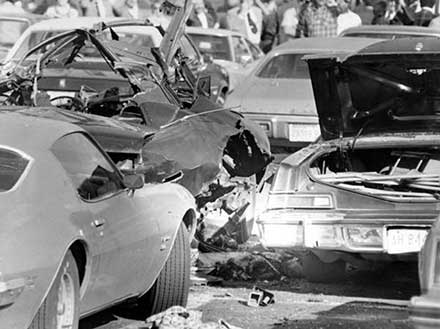
Danny Greene (aka the Irishman), a major figure in Cleveland racketeering, met his demise when a bomb hidden in a car parked next to him exploded in a parking lot at the Brainard Place office building in Lyndhurst, Ohio on October 6, 1977. Greene had just finished up with a dental appointment to correct a loose filling.
Greene previously survived the bombing of his office and home on Waterloo Road in Collinwood as well as two shooting attempts on his life. During one of the shooting attempts, Greene managed to take out his own weapon and kill the alleged assassin, Michael Frato. Green was tried and acquitted of manslaughter charges at the subsequent trial.
Less than two months after Greene was killed, Ronald "The Crab" Carabbia, Ray Ferritto, James "Jack White" Licavoli, Angleo Lonardo, "Butchie" Cisternino and four others were accused of killing Greene and were indicted on charges including aggravated murder, conspiracy and engaging in organized crime. Ferritto eventually talked to the FBI. As a result, Carabbia and Cisternino were convicted of aggravated murder and aggravated arson but cleared of engaging in organized crime, and Licavoli and Lonardo were acquitted on all charges.
Four years later the U.S. Attorneys were able to take Licavoli, Carabbia and four others into federal court, accusing them of racketeering in Greene's death. All six men were convicted. Angelo Lonardo was convicted of racketeering, drug trafficking and conspiracy the following year.
For Further Investigation
- Car Bomb Kills Danny Greene - reprinted article from the Cleveland Plain Dealer posted on Cleveland.com.
- Daniel J. "Danny" Greene- from the Encyclopedia of Cleveland History
- Danny Greene Biography - from Biography.com.
- Archival video footage of a news interview with Danny Greene (June 4, 1977) - courtesy Northeast Ohio Broadcast Archives.
- Tobin, Mike. "The Bomb That Shook Cleveland - Danny Greene's death in a 1977 car explosion led to the dismantling of the city's underworld. His assassin's scheduled release from prison has triggered a range of emotions for Greene's oldest son Danny, among others.." Plain Dealer, The (Cleveland, OH) 22 Sep. 2002, Final, Sunday Mag: 12. NewsBank. Web. 25 May. 2011.
If you found this page interesting, we suggest you also visit Disasters in Cleveland History.


