
Public Housing in Cleveland: A History of Firsts
Cleveland Public Housing Timeline
| Date | Event |
|---|---|
| 1904 | First comprehensive building code passed. Concerns that public housing would lead to socialism. |
| 1900 to 1920s | Population doubled from 381,768 to 796,841 people. Inadequate houses by unskilled builders. |
| Circa 1930 | Ernest J. Bohn learned about a public housing project in New York. |
| 1932 | State Public Housing Act was proposed to build low-cost housing for people with limited incomes. The act passed but it failed to attract businesses since it did not include a tax exemption. |
| 1933 | First national conference about clearing slums [page 276], sponsored by Cleveland. Bohn is named the President of National Association of Housing Officials. |
| The New Deal: 150 million dollars set aside for Public Housing. | |
| Cuyahoga Metropolitan Housing Authority (CMHA) becomes first housing authority in the country. | |
| 1934 | Limited-Dividend Housing bill with tax exemption failed when Cleveland could not raise enough money. |
| 1935 to 1937 | Cedar Central becomes one of the first public housing developments in Ohio. Next Outhwaite, and Lakeview Terrace were built, setting new standards for public housing. |
| 1937 | The Wagner-Steagall Housing Act grants the CMHA authority to create and build and manage public housing, and does so under the direction of Ernest Bohn. |
| 1938 | Cleveland begins "equivalent elimination," in which a new living space is built for every substandard dwelling demolished or built up to code. |
| The end of WWII increases housing problems, and Ernest Bohn begins to be attacked for his methods. | |
| 1949 | Residents can no longer be screened for antisocial problems and for money problems due to the Taft Housing Act. |
| 1953 | Housing and Rent Act expires. |
| Anthony Celebrezze elected mayor. | |
| 1956 | The Hough area population increases from 40,000 residents in 1940 to 82,443 residents in 1956. |
| Operation Demonstrate | |
| Ernest Bohn begins creating housing projects specifically for senior citizens. The Cedar Extension is one of the first projects. | |
| 1957 | Garden Valley is completed and people begin to move in. |
| 1966 | The Hough riots take the lives of four people, injures others and destroys property. The $64.4 million of "stimulus" money had no effect, causing the riots. |
| 1967 | Carl B. Stokes is elected, winning with 52% of the vote. |
| Irving Kriegsfeld replaces Ernest Bohn as president of the CMHA. | |
| 1968 | Cleveland : Now! Gives money to promote urban renewal and revitalization. |
| Glenville Shootout causes the death of seven people and wounds 15. $2.6 millions dollars lost. | |
| Violence in the cities causes more people to flee for the suburbs. | |
| Fair Housing Act prevents racial segregation in housing units. | |
| 1974 | Housing Act of 1974 |
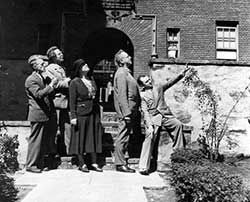
Ernest Bohn pointing at New York apartment, 1934.
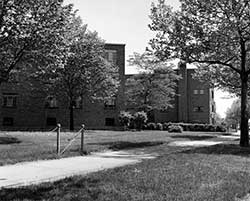
A view of Cedar Central extension apartments, 1934.
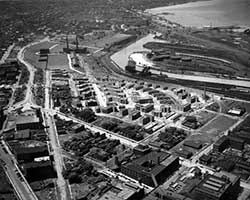 Aerial perspective of Lakeview Terrace public housing development, 1939.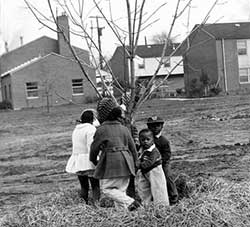
Children planting a tree at Garden Valley, 1961.


