
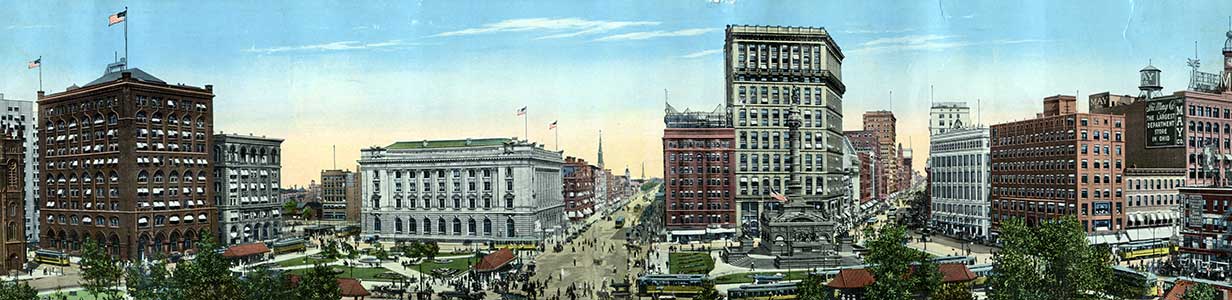
Cleveland State University: A Brief History
Cleveland State University was established in 1964 as a state-assisted university to provide public higher education for citizens of greater Cleveland and northeast Ohio. In its first year, the University acquired the buildings, faculty, staff and programs of Fenn College, a private institution of 2,500 students, and in 1969 the Cleveland-Marshall College of Law (now the Cleveland State University College of Law) became part of CSU.
The Beginnings: YMCA
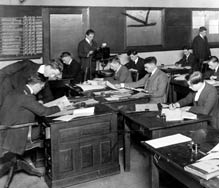
The origins of Fenn College date from 1870 when The Cleveland Young Men's Christian Association created an Educational Committee to provide free evening classes for the benefit of young men coming to the "Y".
That same year Sereno Peck Fenn, a clerk in the Cleveland freight office of the Cleveland, Columbus, & Indianapolis Railroad left his job rather than go contrary to his religious belief against doing unnecessary work on Sundays. While his convictions costed him one job Fenn’s strong beliefs were a major factor in his hiring as cashier-bookkeeper by Henry Sherwin in the newly organized Sherwin-Williams paint company.
Fenn rose quickly through the company becoming a treasurer, partner, major stockholder and one of Sherwin-Williams’ original incorporators. His diligent management was responsible for the company’s sound financial policies and a high rating with local banks. Fenn’s influence was also felt outside of Sherwin-Williams, serving as a director of the Cleveland YMCA from 1868-1920 and as its President for 25 years.
After offering sporadic courses during the 1870's the YMCA moved to establish a formal evening education program in the 1880's. A new day school program was combined with the evening school in 1906 under the name of the Association Institute.
Four different day school programs were started in 1909: The School of Commerce and Finance, The Technical School, The Preparatory School, and The Special School (dropped in1913). The first female students were admitted in 1918. In 1921 the YMCA's educational branch was re-named the Cleveland School of Technology (Y-Tech).
Fenn College
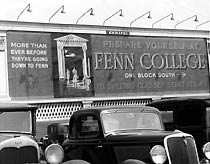
The YMCA offered its first college credit courses in engineering and business in 1923. Dr. Cecil Vincent Thomas, who served simultaneously as the YMCA's Executive Director and the College's first President (1923-1947), guided the school's early development. Classes were held in the Central YMCA building and three converted residences: the Johnson House, the Edwards House, and the Medical Building on Prospect Avenue at East 22nd St.
With several notable private colleges already established in the Cleveland, including Case Institute of Technology and Western Reserve University. Y-Tech sought to attract those students for whom college might have otherwise been financially unattainable by adopting cooperative education as a requirement for its day division students. This program of alternating classroom work with actual work experience in the student's major field allowed students to earn money for tuition.
Two significant events marked 1927; Y-Tech's first graduating class and the start of planning for a junior college that was to become Nash Junior College in 1931. In 1928 the first building built for the College, the Fenn Building, was erected adjacent to the Central YMCA behind the Johnson House.
The need to acquire accreditation led to the educational program being reorganized again in 1929. Laos that year Y-Tech's Board of Governors approved changing the school's name on January 1, 1930 to Fenn College, in honor of Sereno Peck Fenn who contributed $100,000 towards the construction of the Fenn Building and whose bequest to the College formed a major portion of the College's endowment.
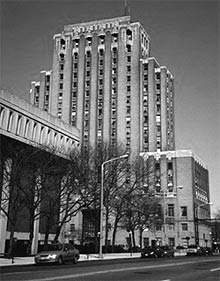
Crowded classrooms and laboratories moved Fenn to acquire the vacant 20 story National Tower and Country Club building at East 24th Street and Euclid Avenue in 1937, becoming the third American college, after the University of Pittsburgh and Northwestern University's Chicago campus to have a skyscrapper on campus. Dedicated as Fenn Tower when it opened in 1938 it not only provided needed classroom and laboratory space it gave the College a more prestigious Euclid Avenue address. Fenn's reputation was further enhanced in 1940 when it received accreditation from the North Central Association of Colleges and Secondary Schools.
During the administration of Dr. Edward Hodnett (1948-1951) Fenn constructed Foster Hall, an engineering and classroom building funded by a donation from Cleveland industrialist, Claude Foster in 1949. At the recommendation of the North Central Association Fenn separated its operations from the Cleveland YMCA in 1950.
Dr. G. Brooks Earnest served as Fenn third President from 1951 until the State of Ohio's takeover of the College's operation in 1965. Under Dr. Earnest Fenn increased the size of the campus by the purchase of the Ohio Motors Building on the west side of East 24th Street across from Fenn Tower. Renovated with classrooms and laboratories the building opened in the 1958 and was dedicated in January 1959 as Stilwell Hall in honor of the Chair of Fenn's Board of Trustees, Charles Stilwell.
Throughout its history Fenn College had managed to avoid incurring an operational budget debt. However, by 1963 Fenn's Administration faced mounting financial difficulties due to increasing operating costs, competition from a new community college and persistent rumors of a possible State takeover. That year the College published The Fenn Plan for Higher Education in Cleveland-Northeast Ohio calling upon the State of Ohio to develop a state university in Cleveland with Fenn College as its nucleus.
During the 1962 Ohio Gubernatorial election campaign candidate James Rhodes proposed that there should be a state university within a 30 mile radius of every citizen. On December 18, 1964 Governor Rhodes signed Ohio Assembly's Amended House Bill No. 2 creating Cleveland State University, Ohio's seventh state university and appointing a Board of Trustees. On March 10. 1965 the Trustees of Fenn College and CSU reached an agreement incorporating Fenn College as the nucleus of the new university.
On June 13, 1965 Fenn College held its last graduation Ceremony at Severance Hall. During its 43 year history Fenn awarded 5951 diplomas to its graduates. On September 1, 1965 representatives of the Fenn and CSU Board of Trustees met for a simple ceremony marking the end of Fenn College and the beginning of Cleveland State University.
CSU College of Law
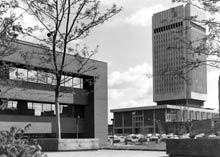
The CSU College of Law developed from the merger of the John Marshall and Cleveland law schools. Cleveland Law School dates from 1897 when Willis Vickery, Arthur Rowley, Charles Bentley, Frederic Howe and Clifford Neff organized the Baldwin University Law School. At the same time Frances Wing founded the Cleveland Law School. The schools merged in 1899 and incorporated as the Cleveland Law School, the law department of the Baldwin University (Baldwin-Wallace), an association that lasted until 1926. Cleveland Law School began instruction in the America Trust Building in downtown Cleveland and soon moved into the Engineer's Building. It was the first law school in Ohio to admit women.
Established by Alfred Benesch, Frank Cullitan and David Meck, John Marshall Law School began classes on 20 September 1916 in the New Guardian Building on Euclid Avenue. In 1919 Marshall moved to the old courthouse on Public Square. Two years later Marshall moved to 242-248 Superior Avenue. Marshall moved again in 1938, this time to the Hippodrome Building, 720 Euclid Avenue. The successful results of its first year's instruction resulted in affiliation with Ohio Northern University in May 1917. After six years the relationship cordially ended and Marshall received authorization to confer degrees under its own name.
In 1946 the two downtown evening law schools consolidated as the Cleveland-Marshall Law School and moved operations to the 1240 Ontario Building, a site occupied until the building was razed for the Justice Center. Between 1963-1967, C-M had a nominal relationship with Baldwin-Wallace College. After regaining independent status C-M initiated its first full-time legal program, graduating its first full-time class in 1970. C-M received state institutional status in 1969, becoming part of CSU as the Cleveland-Marshall College of Law, the largest law college in Ohio. In 2022 the college was renamed the Cleveland State University College of Law.
Cleveland State University
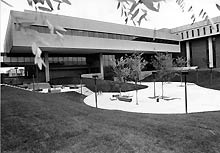
In April 1965, trustee negotiating committees from Fenn and CSU reached an agreement whereby the State would take control of Fenn College, its facilities and personnel, effective 1 September 1965. Dr. Harry Newburn served as acting president until the appointment of Dr. Harold Enarson as CSU's first president in February 1966. Dr. Newburn returned in 1972 as interim president until the appointment of Dr. Walter Waetjen as CSU's second president in 1973.
Dr. Enarson's tenure as President marked a time of tremendous growth. The campus expanded from nine acres and three buildings to over 27 acres with four new classroom and office buildings. Enrollment increased three-fold from 5000 to 15,000. The faculty increased from 90 to 450 members. The academic program added a college of education in 1966, graduate degree programs in 1967, and doctoral degree programs in 1969.
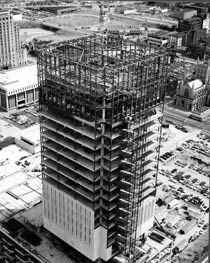
Dr. Waetjen's tenure, 1973-1988, marked a period of maturation as CSU sought to define its role as an urban university. Its academic program grew and significant research and public-service programs such as the Legal Clinic, the Speech and Hearing Clinic, and the Center for Neighborhood Development were add. Campus growth during this period included the openings of the Physical Education Building (1973), University Center (1974), the Law Building (1977), and the Science and Research Building (1981).
During the administration of Dr. John Flower, 1988-1992, the University instituted a major organizational change that reflected the importance of positive racial and community relations. Dr. Flower's tenure also marked the start of a transition period in University labor relations as first the classified staff, followed by the faculty and the professional staff all formed unions to represent them in negotiations with the University. In 1990 the Music and Communications building opened, and a long time desire was realized when the Convocation Center opened in 1991.
Faced with the demographics of a stagnating or declining pool of college age students, the University undertook several major projects to improve student services and retention during the administration of Dr. Claire Van Ummersen, 1993-2001. Improvements included the conversion to the semester system in 1998 and the implementation of a modern information technology infrastructure. While attempting to update its computer system the University encountered delays and substantial increased costs in implementing the computer software that was supposed to allow the University to integrate its various administrative functions. This, combined with a period of decreasing levels of financial support from the State of Ohio resulted in a rapid increase in tuition and has limited program development and improvements. In the later half of the 1990's the campus continued to grow with the opening of the Health Sciences Center (1997), Monte Ahuja Hall (1998) and the Urban Affairs College building (2001).
CSU in the 21st Century
Dr. Michael Schwartz (1937-2024)
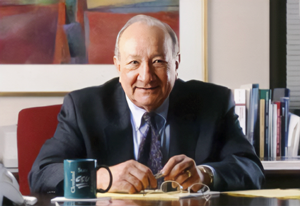
On 26 September 2002, Dr. Michael Schwartz was installed as CSU's fifth President. Putting forth the goal of being a first-rate comprehensive university that serves its students, the region and the State of Ohio, Dr. Schwartz oversaw immense changes while preserving and strengthening the University's fundamental purposes of teaching, research, scholarship, and service. A tireless advocate of CSU throughout the Greater Cleveland area, Dr. Schwartz worked to make sure that the community was aware of all the good things happening on campus.
Enhancements to the University's academic program included the institution of academic standards, an honors program, a scholars program, learning communities, an undergraduate research program; a common reading program; and revamped general education requirements. Among the new program started up during Dr. Schwartz's presidency were the Arabic language and Middle Eastern studies program; the Confucius Institute designation; the Center for School Leadership; the International Business Program; the Center for Gene Regulation in Health and Disease; collaborations with the Cleveland Clinic's Lerner Research Institute; and programs to improve the bar passage rate for students.
The University's revised campus master plan, Building Blocks for the Future, charted more than $350 million in new construction and renovations, changing the once inward-looking face of the campus architecture to one that opens out towards the community. Changes included converting Fenn Tower from a multi-use building into a residence hall; enclosing the first floor of Main Classroom; renovating the entrance to the CSU College of Law's Bert. L. Wolstein Hall; renovating the second floor of Rhodes Tower West; Renovation of Parker Hannifin Hall (Howe Mansion); construction of the Administration Center; construction of the College of Education and Human Services Building; and the demolition of University Center and construction of a new student center.
Dr. Ronald M. Berkman
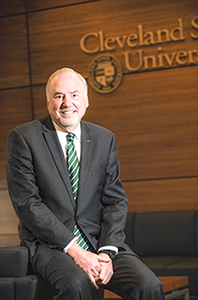
Ronald M. Berkman served as the 6th president of Cleveland State University from 2009 to 2018. During his tenure, he implemented several initiatives aimed at advancing the university's academic reputation, enhancing student success, and fostering community engagement.
Under Berkman's leadership, Cleveland State University experienced significant growth and transformation. He prioritized student-centered initiatives, including enhancing academic advising, expanding scholarships, and promoting experiential learning opportunities. Berkman focused on improving retention and graduation rates, as well as strengthening student support services.
Berkman played a vital role in expanding and modernizing the university's campus. Notable projects included the construction of the Center for Innovation in Medical Professions, the renovation of the Student Center, and the establishment of the Cleveland State University College of Law's new building. He forged strong partnerships with local businesses, civic organizations, and government entities to strengthen the university's role as an economic and cultural anchor in the region. Dr Berkman retired in 2018.
Dr. Harlan M. Sands
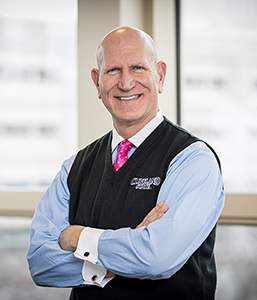
Harlan M. Sands served as the President of Cleveland State University from June 2018 to October 2020. Under Sands' leadership, Cleveland State University prioritized student success and access to higher education. Efforts were made to improve graduation and retention rates, increase enrollment, and enhance student support services. The university expanded scholarship opportunities and implemented initiatives to foster student engagement and career readiness.
Sands also emphasized strengthening community partnerships and collaboration. He aimed to enhance the university's relationships with local businesses, organizations, and government entities to create more opportunities for experiential learning, internships, and employment prospects for students. During his tenure, the university opened the new Center for Innovation in Medical Professions and renovated of the Washkewicz College of Engineering.
Sands resigned from his position as President of Cleveland State University in October 2020.
Dr. Laura J. Bloomberg
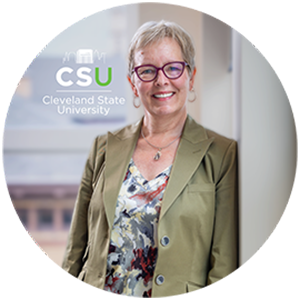
Dr. Laura Bloomberg was appointed the eighth president of Cleveland State University (CSU) in the spring of 2022. She had previously served at CSU as provost and senior vice president for academic affairs since the fall of 2021. As established in her inaugural address, Bloomberg’s leadership and vision for CSU centers on the theme of “Living well together, on our campus, in our city.” With this focus, she has guided strategic initiatives that support CSU’s ability to create an academic community in which everyone can thrive and enrich the surrounding region.
These initiatives include:
- A college realignment to bring together existing academic programs in ways that provide clear pathways and new learning opportunities to all student
- A new campus master plan, which would renovate CSU’s downtown campus and further integrate it into the city of Cleveland; and
- A university rebranding to share the message that We Are Cleveland State University.
Today's CSU
Today, Cleveland State University offers over 1,000 courses in 200 fields of study at the undergraduate and graduate levels, as well as professional certificate and continuing education programs, continuing Fenn's legacy through over 250 partnerships with local businesses, schools, hospitals, and other institutions. CSU encompasses 40 buildings on 85 acres in the heart of Cleveland's downtown. Among these buildings is the iconic Fenn Tower, standing as a reminder of the early years when Fenn College was affectionately known as the "Campus in the Clouds." This beautiful and historic tower serves as a reminder of the university's roots and its commitment to providing accessible and innovative education to its students.


